9 October 2026
Bespoke Wall Art: How to Create a Piece for Your Room
Plan wall art around your room, taste and budget. Learn what to include in a brief and how a custom art print differs from a handmade commission.
By Ben Gordon
By Ben Gordon · 16 September 2026 · 5 min read
Use a simple width chart to plan artwork above your sofa, with clear examples for single prints, pairs and groups that include frames and gaps.
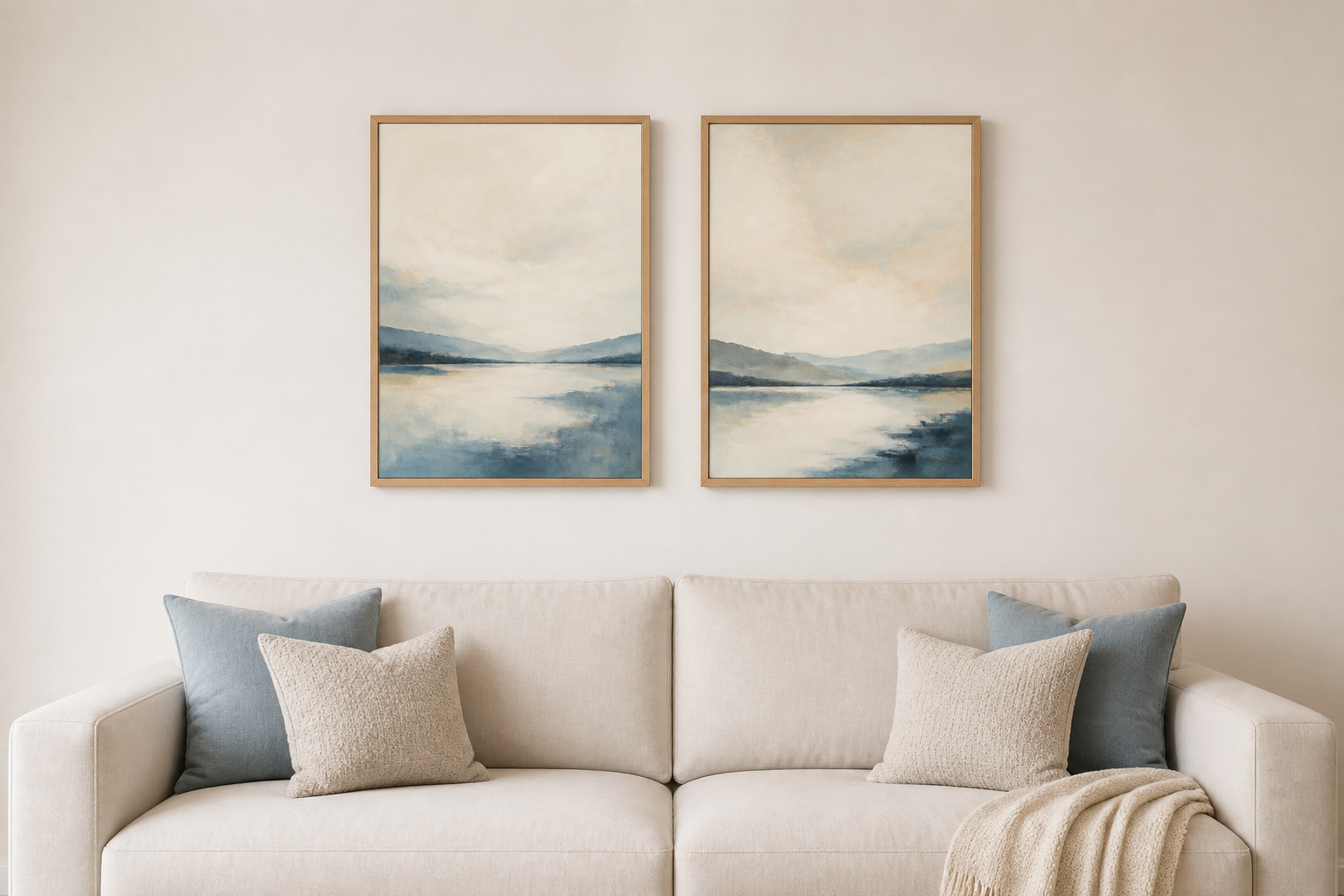
Start by measuring your sofa from arm to arm. Around two-thirds of that width is a useful starting point for the artwork or the complete group of frames above it. Then test the arrangement on the wall before ordering.
This is a decorating guideline, not a requirement. A smaller piece can create a deliberately quiet focal point; a wider arrangement can give the wall more presence. The aim is a proportion you enjoy in your room.
For one picture, use the outside width of the frame. For a pair or group, add every frame's outside width and every gap between them.
Total arrangement width = frame widths added together + gaps between frames.
Paper size, image size and framed size may be different. A print described as 50 × 75 cm does not automatically have an outside frame width of 75 cm. Check the product dimensions, including your selected frame and mount.
The table gives a two-thirds starting point and a broader 60–75% range to try with paper outlines. The figures refer to the complete arrangement, including frames and gaps, rather than individual print sizes.
| Sofa width | About two-thirds | A 60–75% range to try |
|---|---|---|
| 140 cm | 93 cm | 84–105 cm |
| 160 cm | 107 cm | 96–120 cm |
| 180 cm | 120 cm | 108–135 cm |
| 200 cm | 133 cm | 120–150 cm |
| 220 cm | 147 cm | 132–165 cm |
| 240 cm | 160 cm | 144–180 cm |
Artist Nicola Briggs also suggests roughly two-thirds of sofa width as a starting point. Use that proportion to begin comparing layouts, then adjust for the room and the artwork.
These examples use hypothetical outside frame widths, not Create Prints product sizes. Substitute the actual dimensions of the frames you choose.
The third arrangement is wider than the suggested range for the smaller sofa. It might still suit the room, but it is a different proportion. Measuring first lets you make that choice deliberately.
A single piece gives the wall a clear focal point and is straightforward to position. A landscape composition naturally offers width, but a square or portrait can also work if you prefer its shape.
A pair can span a wider area while keeping the arrangement simple. Similar frame finishes or a shared colour palette can connect the pictures. They do not need to be identical.
A gallery wall gives you more flexibility with smaller works. Lay out the full group on the floor first, then transfer the arrangement to the wall with paper templates. Check the outside shape of the group as well as the relationship between neighbouring frames.
Try a gap of around 5–8 cm between frames as a starting point. Adjust it to the scale of the pieces and keep the spacing intentional.
Try the bottom of the frame around 20–25 cm above the sofa back, then check it in the room. This is a starting point, not a fixed mounting height: cushions, tall backrests, frame depth and the way people sit can all affect the position.
Leave enough clearance that someone leaning back will not knock the frame. Judge the arrangement from both a standing and seated position. Centre the artwork on the sofa when that makes sense for the layout, while allowing for nearby windows, lamps and other features.
Use fixings suitable for the frame's weight and the wall, following the frame and fixing instructions.
A room photo can help you choose artwork that relates to the interior, but it does not replace a tape measure. Check dimensions rather than estimating them from a mockup.
Browse the living-room collection, or create an artwork from a description or room reference. Compare the available sizes and framing options with your layout before ordering.
If you are preparing your own image, our AI art printing guide explains how resolution and cropping affect the finished print.
Around 133 cm is a two-thirds starting point for the full arrangement. Try a span of 120–150 cm with paper templates, including all frame widths and gaps.
Yes. Use the finished outside dimensions. The image or paper size alone may underestimate the space the order will occupy.
Yes. You do not have to fill two-thirds of the width. Test the scale on the wall and choose the effect you prefer.
That is a simple option for a row of similar pieces. Mixed-size groups can use a shared centre line or a planned outer shape instead. Lay out the group before making holes.
Every print is analysed for colour and room fit — or describe your space and we'll make something for it.
9 October 2026
Plan wall art around your room, taste and budget. Learn what to include in a brief and how a custom art print differs from a handmade commission.
By Ben Gordon
4 October 2026
Bring artwork together through colour, subject, frames or spacing. Practical ideas for choosing a pair, adding to an existing print and planning a gallery wall.
By Ben Gordon
25 September 2026
Print a ChatGPT image as a poster or framed print with the Create Prints plugin. Sizes, prices and delivery times for Great Britain and the US.
By Ben Gordon