9 October 2026
Bespoke Wall Art: How to Create a Piece for Your Room
Plan wall art around your room, taste and budget. Learn what to include in a brief and how a custom art print differs from a handmade commission.
By Ben Gordon
By Ben Gordon · 21 September 2026 · 5 min read
Choose bedroom artwork you enjoy unwinding with. Explore colour, subject, scale, reflections and practical placement above a bed or on another wall.
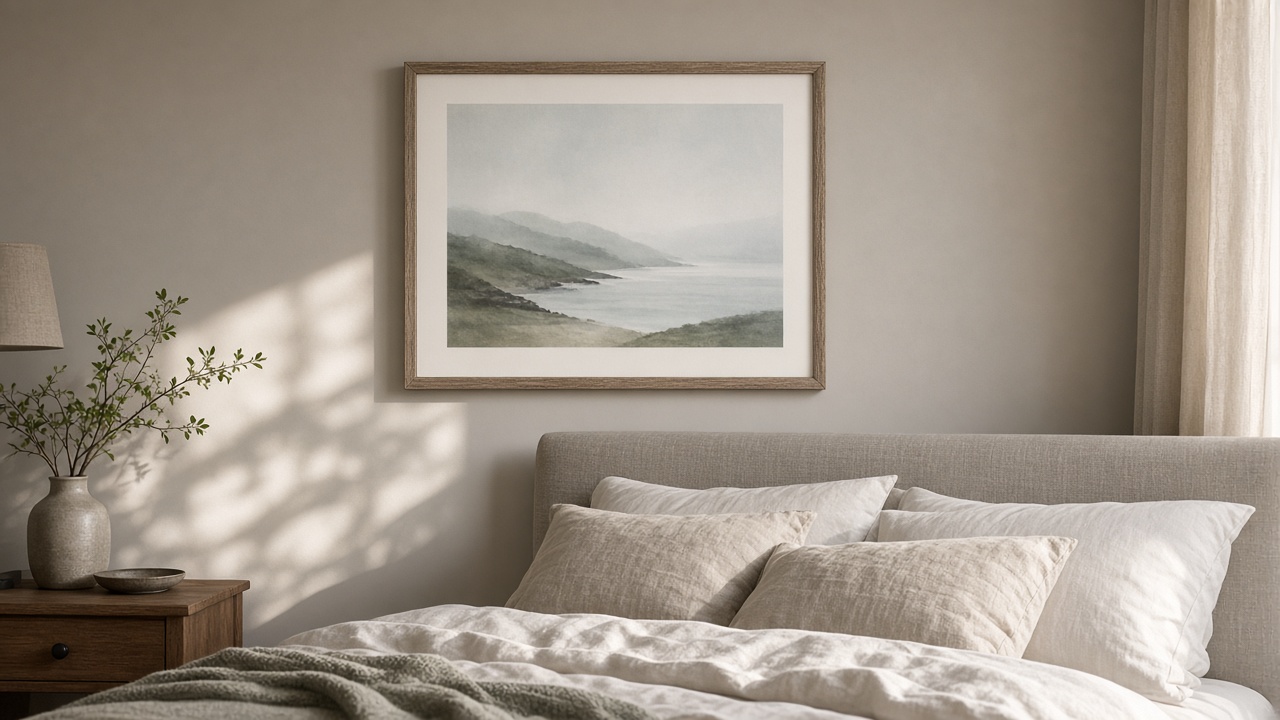
Relaxing bedroom wall art is artwork you enjoy seeing in a space used for rest. Soft landscapes, simple abstracts and gentle botanical images can be good starting points, but your own response matters more than a label saying “calming”.
Consider the whole room: the bedding, the light, the position of the picture and what you see from the bed. A print that looks right in a bright preview may feel different under a bedside lamp.
Start with a subject you like. You might prefer an open landscape, a few botanical shapes, an abstract composition or a familiar place. A favourite photograph can be just as appropriate as a new piece of art.
For a quieter appearance, compare pictures with fewer competing details, softer edges and more open space. If you enjoy rich colour or intricate work, you do not have to exclude it. The aim is a bedroom that feels comfortable to you.
Art can contribute to the atmosphere of a room, but no particular image can promise better sleep.
A muted blue and a vivid blue can have very different effects in a room. Consider the strength of the colour and the contrast between light and dark areas, as well as the name of the hue.
For a restrained palette, try soft greens, warm creams, dusty blues or earthy pinks. Pick up one colour from the bedding if you want a connection with the room. Monochrome is another option, though a strong black-and-white image may still be visually striking.
Compare a shortlist with the room in daylight and lamplight. If you share the bedroom, include both people's preferences in the choice.
Above the headboard is an obvious position, but it is not the only one. The wall opposite the bed lets you see the artwork while resting. A dressing area or reading corner can suit a smaller piece.
Look for reflections from windows and lamps. Check that the artwork will not interfere with doors, switches or furniture. A wall with more space around it may suit the picture better than the first empty area you notice.
Above a bed, use the headboard as a reference. A piece or group spanning roughly two-thirds of its width is one starting point to test, not a requirement.
For a 150 cm headboard, that suggests about 100 cm across the complete arrangement. Include outside frame widths and any gaps. A single smaller picture can also work if you prefer the look.
Cut paper templates to the proposed framed dimensions. View them from the doorway, beside the bed and from the bed itself. Check product dimensions rather than assuming the stated print size includes the frame.
With a headboard, you can begin by trying the frame around 15–25 cm above it, then adjust for the actual bed and artwork. This is a visual starting point, not a safety measurement.
Make sure anyone sitting up or leaning back has ample clearance from the frame. Without a headboard, do not rely on a small fixed gap above the mattress; check the space occupied by pillows and people, or choose another wall.
Use fixings appropriate to the wall and the framed artwork's weight, following the supplied instructions. If you are unsure about secure mounting above a bed, ask a qualified installer. The Profile guide to hanging art above a bed also discusses placement and fixing considerations.
Natural wood, white and dark frames each change the outline of the artwork. Compare the whole combination with your furniture and bedding.
Glazing can reflect a bedside lamp or window. Try adjusting the position of the lamp or artwork, and check which glazing options are available. A matte-looking image does not guarantee a reflection-free framed surface.
If you already own a frame, check its opening and any mount before ordering a print to fit it.
On Create Prints, describe the artwork you want or upload a room photo for visual guidance. Include the subject, palette and shape, then review the image before choosing the available size and framing options.
For example:
A quiet coastal landscape in muted grey-green and warm cream, with a low horizon and broad simple shapes. Landscape format, no lettering, for a bedroom with pale linen and oak furniture.
You can also browse the bedroom collection or the Quiet collection. If you already have artwork from ChatGPT or Midjourney, use the Create Prints plugin or MCP connection to print it.
Landscapes, botanicals, abstracts and personal photographs are all options. Compare how the image feels to you rather than relying on a particular subject to create calm.
No. Consider the full palette, contrast and lighting. Warm neutrals, soft greens and other colours can suit a bedroom just as well.
No. The opposite wall, a reading corner or a dressing area may be a better place to enjoy it. Choose a position with suitable space and secure mounting.
It depends on the file and the selected size. See our printing guide for resolution and cropping advice.
Pick a picture you enjoy, test its size and check it under your bedroom lighting. Browse bedroom prints or create a piece for your space.
Every print is analysed for colour and room fit — or describe your space and we'll make something for it.
9 October 2026
Plan wall art around your room, taste and budget. Learn what to include in a brief and how a custom art print differs from a handmade commission.
By Ben Gordon
4 October 2026
Bring artwork together through colour, subject, frames or spacing. Practical ideas for choosing a pair, adding to an existing print and planning a gallery wall.
By Ben Gordon
25 September 2026
Print a ChatGPT image as a poster or framed print with the Create Prints plugin. Sizes, prices and delivery times for Great Britain and the US.
By Ben Gordon